The core activities of an ancient school were reading, writing, and arithmetic. We offer these in various forms suitable for a wide range of different ages and abilities, from Year 3 to Year 11; see below for more details and here for links to the National Curriculum. Every ancient schoolroom includes these three activities, which together with putting on the costumes and taking them off normally take about an hour and a quarter to complete. If you can organise longer sessions, additional activities can be included; see the list below.
Core activities
Reading
We start with reading because it was significantly different in the ancient world: texts were normally handwritten in capital letters without word division or punctuation. And ancient children learned to read on archaic poetry, typically Homer (for Greek speakers) or Virgil (for Latin speakers). So in our Egyptian schoolroom most pupils read from Dryden’s translation of Homer’s Iliad handwritten ancient-style on papyrus; in our British schoolroom most read from Dryden’s translation of Virgil’s Aeneid similarly written on a wooden tablet. Most pupils do surprisingly well with these texts, but we have fables from Phaedrus available in a more recent translation for younger children and others who find Dryden too challenging. Pupils are asked to spend 10-15 minutes deciphering part of the text (they can do as many or as few lines as they feel comfortable with in that time, and can work together or independently) and practising reading that part aloud until they can do so fluently. Then they come back to a teacher to go over it and discuss anything they had trouble with.
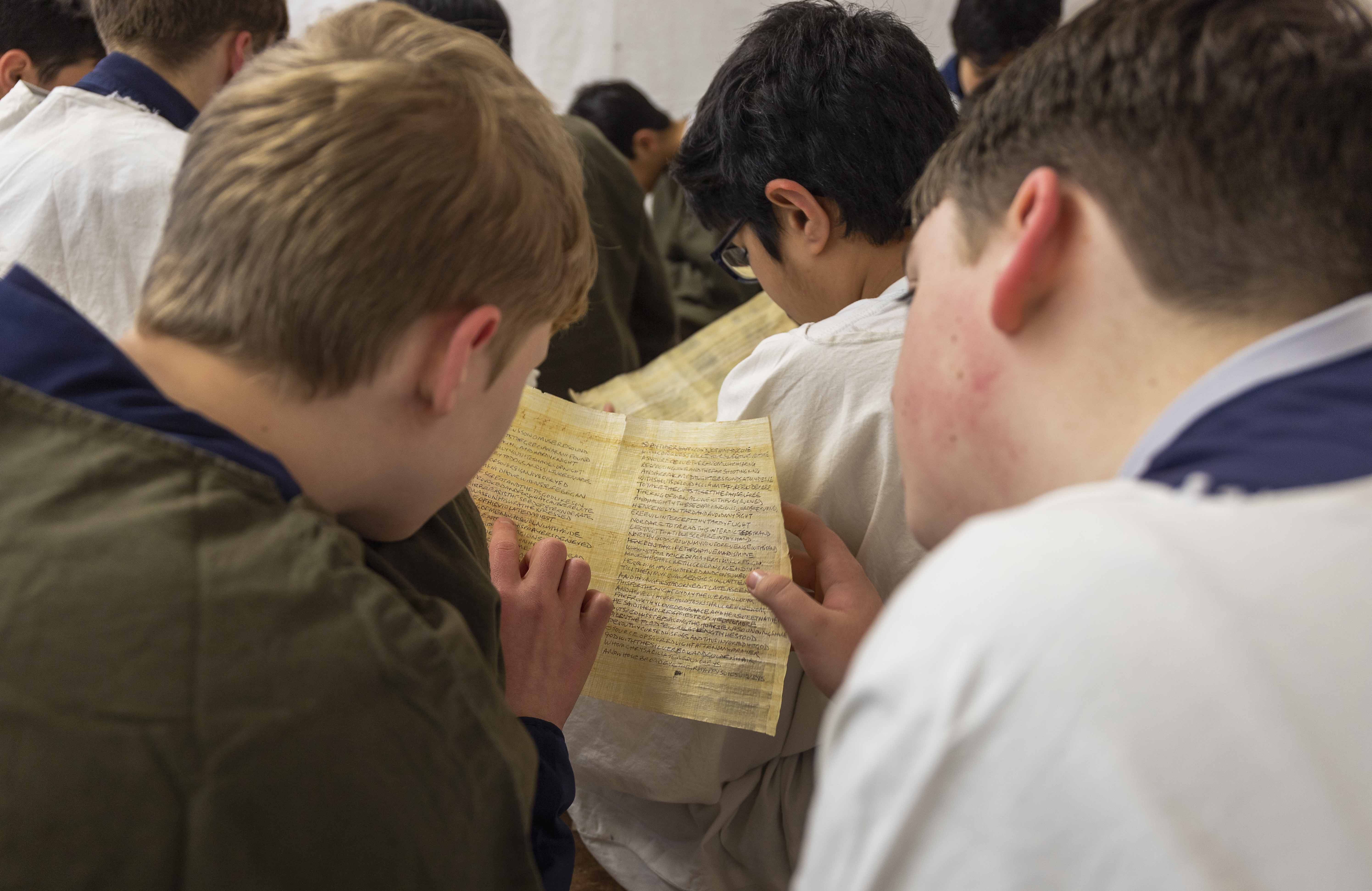
Writing on a wax tablet
Romans loved to write on wax tablets, which are endlessly re-usable; you inscribe words into the wax with the point of a stylus and rub them out with the flat end. They did not erase a tablet until they needed to re-use it, so that’s what we do as well: participants start the writing exercise by erasing their tablets. In the Egyptian version of the ancient schoolroom they then choose one of the English poems on the wall (these vary in difficulty, so the pupils can select a level they are happy with), copy it onto the tablet, work out what it means (these poems are of course also written in capitals without word division), practise reading it aloud, and then come to a teacher to read the poem aloud from the tablet and discuss it. In the British version of the schoolroom pupils do the writing in pairs, as a dictation exercise: one dictates a (translation of a) real Roman letter found at Vindolanda to the other, who writes it on the tablet, and then they swap roles to dictate a second letter in the other direction.

Arithmetic
Addition, subtraction and multiplication in Roman numerals sounds hard, but actually it’s easy — often easier than it would be in Arabic numerals. You don’t need to know your times tables, and you don’t even have to write anything down; we do it all with dried beans on counting boards. If you don’t know how Roman numerals work, or even what they are, that’s no problem; we’ll start by explaining that. Overall arithmetic is the ancient schoolroom’s most popular activity, which is quite something when you consider the usual popularity of modern arithmetic among modern children. For more information on what we do, see https://www.youtube.com/watch?v=c-2I09cmth0 and our other videos at https://www.youtube.com/@ReadingAncientSchoolroom.

Additional activities – Options always available
Writing on ostraca
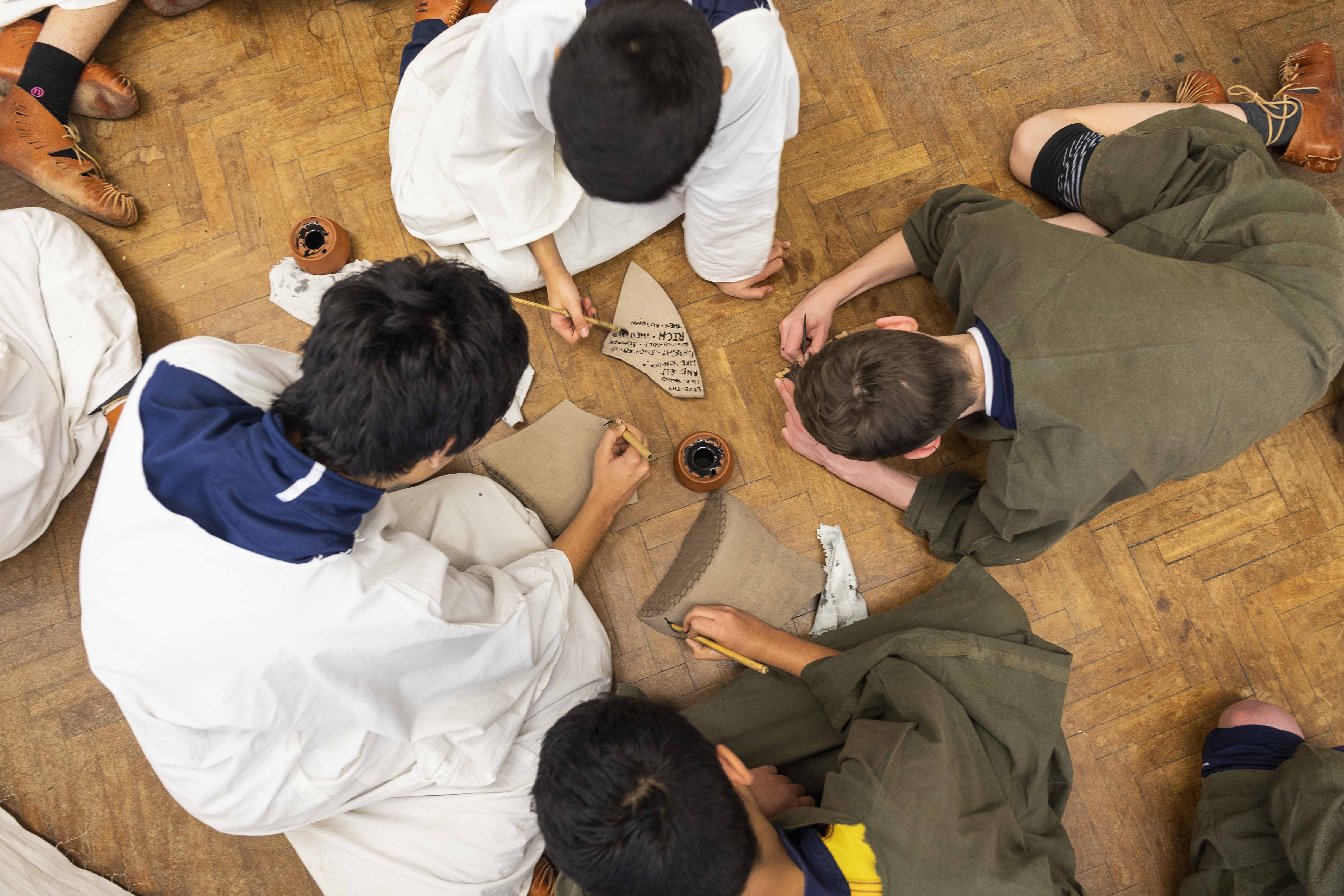
Pieces of broken pottery, called ostraca, were commonly used in antiquity as writing materials. You can write on unglazed pottery with a pen and ink, so we do: with a reed pen, ink and an inkwell. The result can be a little messy, so please only ask for ostraca if your floor can cope. In the Egyptian version of the schoolroom pupils copy English poetry from the walls onto the ostraca and then practise reading those poems; in the British version they copy Latin poetry from wooden tablets. Most pupils do not understand the Latin (it’s the beginning of the Aeneid), and that’s fine: copying text you cannot yet understand is an authentic ancient school task.
More arithmetic
If there is more time, pupils can also learn how to do division with beans and a counting board, and even how to calculate compound interest on a loan. Such exercises are typically more suitable for the older pupils, but some adventurous young ones enjoy them too. Compound interest enables pupils to learn an important life lesson — the interest accumulates with terrifying speed — in a positive fashion, as they play the greedy bankers and we the hapless borrowers.

Latin
Our Latin exercises are based on ones actually used during the Roman empire by Greek speakers learning Latin. Most are dialogues that students study, discuss and perform in pairs. We have options at all levels from complete beginners to advanced, and to ensure suitability we can show them to the pupils’ regular Latin teacher in advance and add/subtract glosses as needed.

Additional activities available during selected events
Magical gems
Pupils learn about ancient magical gems and the protection against stomache-ache offered by the Egyptian divinity Chnoubis before making their own Chnoubis gems out of ruby or jasper. (Actually our gem blanks are soy wax, which is a lot easier to carve safely with a wooden stylus. But they look like rubies and jaspers and have the advantage that the pupils can take them home.)


Curses
Hundreds of curse tablets survive from Roman Britain, telling us how ordinary people sought justice for anonymous crimes such as theft of clothing at the baths. We can show you real curses and teach you how to make your own Roman-style curse tablets — but only outside the schoolroom, since no decent Roman teacher would allow such an activity inside.
Ink making
Pupils participate in making ink from charcoal, gum Arabic and water ground together with a mortar and pestle.
Introduction to Greek pottery and the Greek alphabet
Choose this activity to find out about stories pottery can tells about ancient Greek life and decorate your own pottery sherd with Greek letters while mastering the Greek alphabet. (The Greek alphabet is also available as a stand-alone activity.)
Geometry
The Greeks often drew diagrams in wet sand, which turns out to be a surprisingly good medium for geometry. We do basic Euclidian constructions on a sand table using a straightedge and compasses. Pupils love this activity, but it is only suitable for small groups (only one pupil can do it at a time) of relatively well-behaved children.
Spoken Latin
Salve! Visne Latine loqui? Possumus – et tu quoque potes, si conari velis.
Spinning and sewing
Pupils can learn to spin yarn from raw wool, and/or to sew together a Roman purse. The sewing activity is good for younger children (it uses coarse fabric and a blunt needle), but the spinning requires considerable dexterity. Only one member of our team can do these activities, so they are only available when she is.
Graffiti workshop
The ancients were just as prone to write on walls as we are, and they said many of the same things – but teachers did not let children write on the walls of their own school, so this workshop is held outside the schoolroom. It consists of an introduction to Egyptian or Roman graffiti followed by a practical session.

Reed pen making
Pens are objects we use every day, but how much do you know about their history and the ways ancients used them? Turning a piece of bamboo into a pen then using that pen to write all with a few well-thought-out movements is a magical experience – and you may keep the pen afterwards. Since this activity involves using a sharp knife, specific parental consent is required.
 Reading Ancient Schoolroom