Reading Exercise
Ancient books were written by hand on papyrus rolls (volumina) several meters long; we could not face doing quite that much copying, so our papyri are much shorter, usually only the size of an A4 page. But they are made of real Egyptian papyrus (purchased from the Roman shop), and all the text on them has been handwritten by dedicated schoolroom volunteers. Naturally, the quality of their handwriting is variable, and occasionally there is a copying mistake, so some papyri are easier to read than others – but that is the authentic ancient experience. Papyrus is stronger than paper but still pretty fragile, so many of our older papyri have cracks, which we repair by gluing strips of papyrus to the back of the sheet (fortunately ancient papyrus rolls were only written on one side). Although these repairs are totally authentic, we hope participants will be extra gentle with our papyri to avoid the need for more and more repairs.

Writing exercises
Romans used wax tablets (tabellae ceratae) for writing letters, business documents, and school exercises; although small enough to fit comfortably in one hand the tablets usually held a lot of text, because the ancients wrote very small. The writing implement is a stylus (stilus), a pointed piece of metal, bone or wood; most of our styluses are made of iron and not quite as sharply pointed as the ancient ones, to avoid accidents. The tablets and metal styluses come from the Roman shop, but we also have some wooden styluses that we make ourselves by sharpening twigs with a pencil sharpener. The wax is beeswax, with a bit of black dye. Tablets can be erased by smoothing the wax with the back end of the stylus. Erasing becomes difficult when pupils press too hard with the stylus and gouge out the wax; under those circumstances we heat a stylus in a candle flame and melt the wax back into position, sometimes adding more. With this loving treatment many of our original tablets from 2014 are still in fine shape despite getting a lot of use.

Schoolroom participants write on the ostraca using dip pens (calami); in Roman Egypt these would usually have been made from reeds, and we have some reed pens (purchased from the Roman shop). But eventually Alan Cole, curator of the Museum of Writing in London, was kind enough to teach us how to make dip pens ourselves, and therefore most of our pens are made by us – not from reeds, since the ones on the university campus don’t seem to be strong enough, but from the bamboo that rather conveniently grows in the garden of Assistant Schoolroom Director Emma Aston. We have also made some quill pens (from feathers naturally shed by free-range geese); these are beautiful but were not often used in Roman Egypt, so we rarely deploy them in the schoolroom.

Most of the time, the ink (atramentum) we use with these pens is not actually ink, but waterbase paint diluted to the consistency of ink; this is a little harder to use than real ink would be, but much easier to wash off. (It can still stain clothing, though, which is an additional reason to make sure all modern clothing is covered by your tunic when you’re in the schoolroom.) It is always black, since that is the only colour in which the Romans wrote. We store the ink in replica ancient bottles so that we can shake it just before handing it out, since the paint and water tend to separate if allowed to stand. Sometimes we make our own ink from charcoal and gum Arabic, thanks to lessons from Marina Sartori, an Oxford Egyptologist. When in use, the ink sits in replica Roman inkwells (atramentaria) from the Roman shop; by design these are very hard to tip over, but some people can manage it, so please be careful around the inkwells. Sometimes we are lucky enough to be joined by inkwell specialist Hella Eckhardt, who explains the different kinds of inkwells used in antiquity; she is not very excited by ours, which are perfectly ordinary, but as with all aspects of the schoolroom ordinary is what we’re aiming at.

In order to try to contain the ink we issue pen-wipers (panni) with every pen; these were also used in ancient schools, for the same reasons. To achieve maximum authenticity (and effectiveness, as worn cloth is more absorbent than new cloth) our pen-wipers really are pieces cut from old clothing, but we regularly wash them (on a very gentle cycle so as not to remove all the ink stains) despite knowing that that is not authentic at all. And then after each washing we have to trim off the loose threads – what a lot of work for an old rag!

Maths
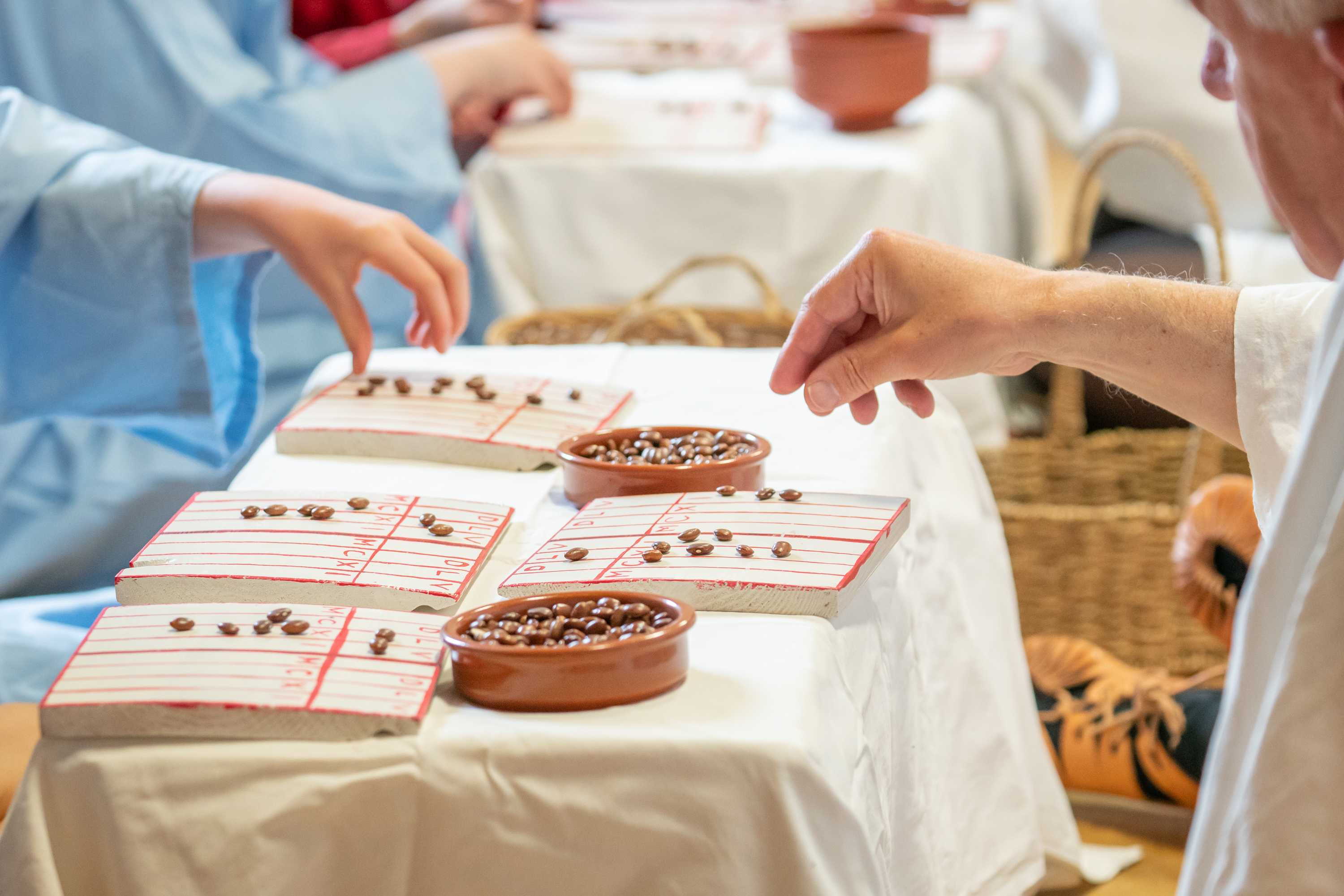
Maths lessons use dried beans (calculi) on counting boards (tabulae) with Roman numerals; we have a variety of these made of stone and wood. Most of them we made ourselves (you could too – they are very simple).
Other equipment
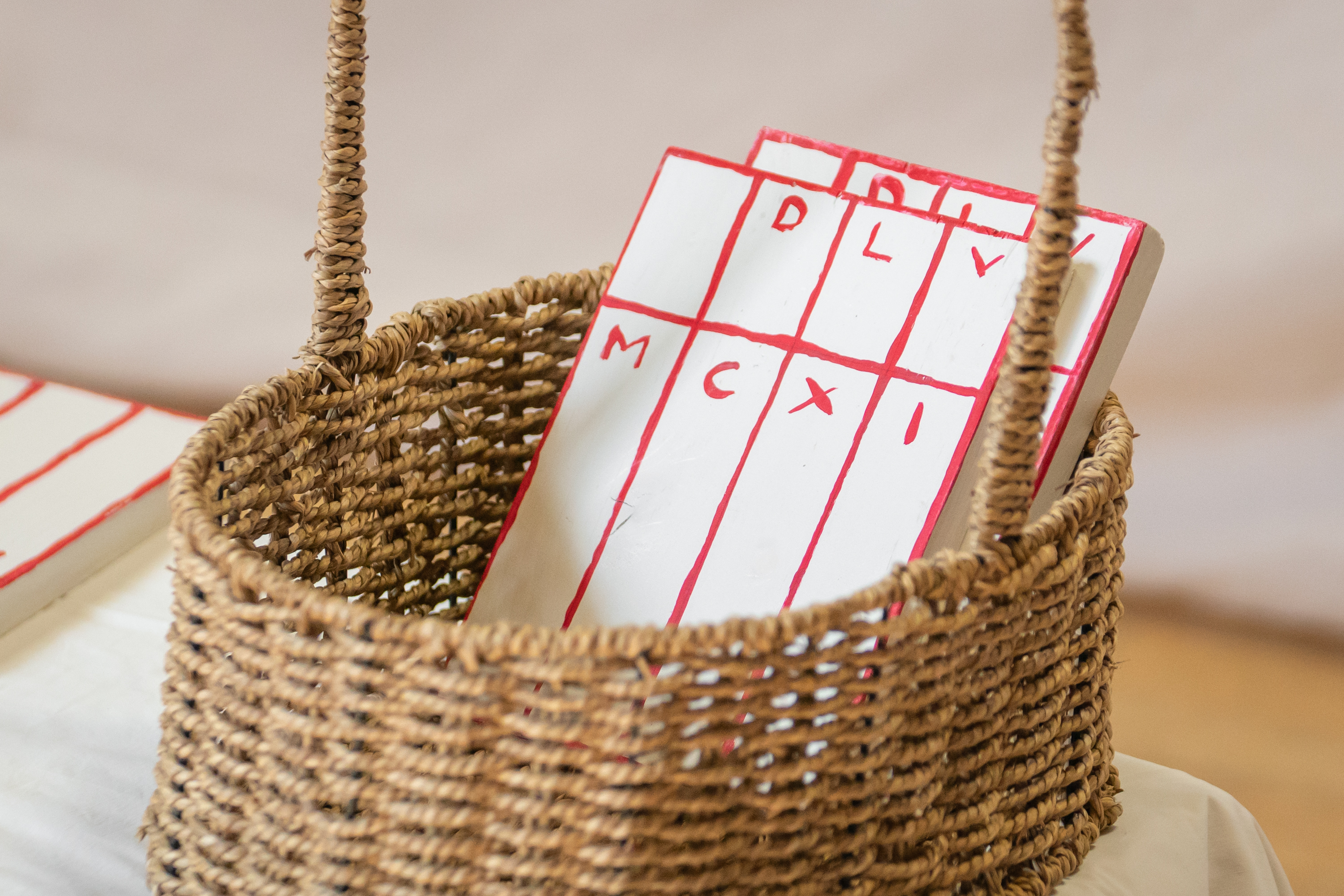
The school equipment is kept in baskets; some of these are replicas of palm-frond tote baskets found in Bar Kochba (from the Roman shop), and others are baskets we have been given. The papyri are stored in cylinders plaited from willow by a neighbour of the Director, Bob Summers.
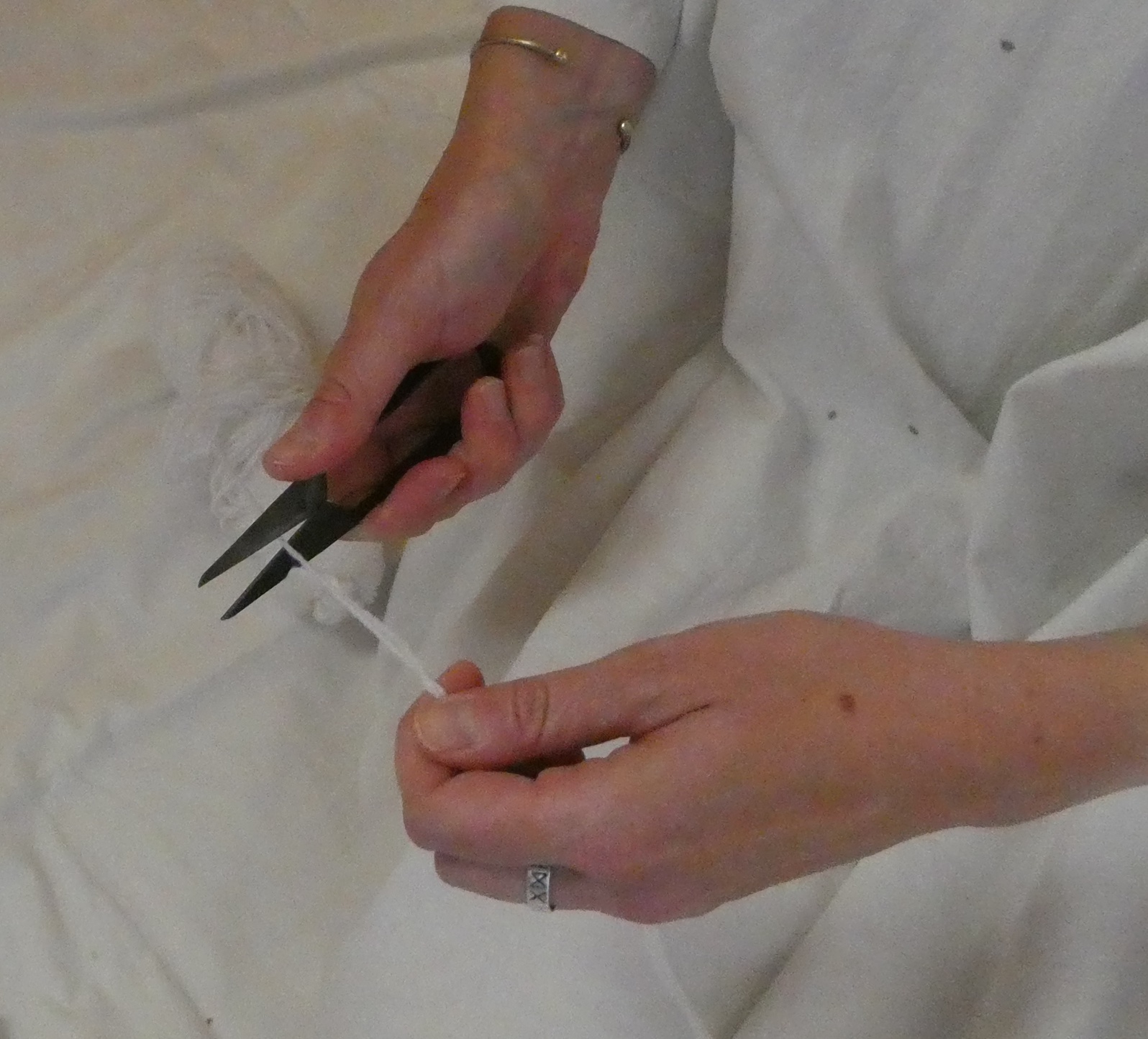
We have a pair of Roman scissors, normally used for cutting yarn in the gems activity.
At on-campus events, where there is a full-time classroom slave on call (usually the Director), thirsty teachers may ask for water in a Roman jug and cup.

 Reading Ancient Schoolroom